Master the Pavilion: How to Avoid “Bulginess” in Your Colored Stone Faceting
Every lapidary artist faces the same moment of truth when sitting down at the mast: how much rough do I sacrifice for brilliance? While maximizing yield is central to the gem-cutting business, a dangerous line separates a well-proportioned deep stone from a cut that suffers from “bulginess.”
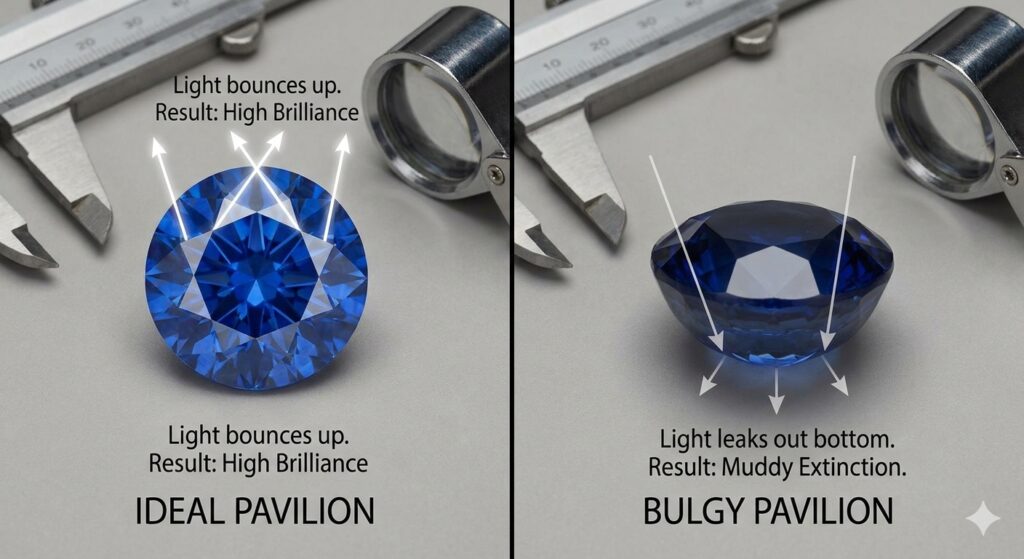
In colored stone faceting, bulginess refers to an intentional or poorly planned outward-curving over-cutting of a gem’s pavilion (or sometimes the crown), resulting in a swollen, bottom-heavy profile.
Understanding the mechanics behind bulginess is essential for amateur cutters transitioning from strictly following standard diagrams to manipulating custom angles for real-world rough. Let’s break down the optical and financial trade-offs of the bulge, and how you can avoid it on your faceting machine.
⚖️ The Commercial Temptation: Yield vs. Color
- The Yield Factor: Gemstone rough is expensive. Cutting flat, mathematically ideal facets can easily waste 65% to 75% of the original crystal. To preserve weight, commercial cutters wrap facets around the curved outer rind of the rough, leaving a heavy “belly” that can bloat a stone’s carat weight by 35% or more.
- Deepening Pale Material: Color dictates roughly 60% of a stone’s value. In light-toned rough (like pale aquamarine or light tourmaline), a bulgy, extra-deep pavilion forces light to travel a longer path through the crystal lattice. This increased path length allows more light absorption, which can artificially darken and enrich the stone’s face-up color.
⚠️ The Optical Penalty: True Extinction
While a bulge might save weight or save a pale stone, it breaks the laws of physics when it comes to light return.
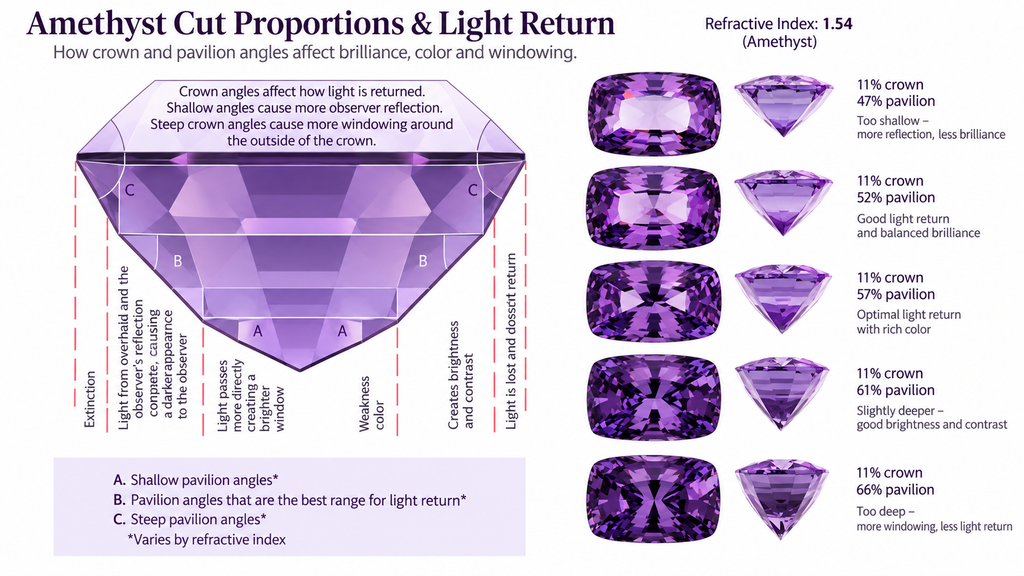
Every mineral has a specific Refractive Index (RI) that dictates its critical angle. For light to reflect back to the viewer’s eye, pavilion facets must be cut within a specific, narrow angular window.
When you introduce an excessive bulge, the facet angles rapidly shift away from the ideal meeting points. Instead of acting like perfect internal mirrors, these over-steepened, curved surfaces cause the light to drop right out the bottom of the gem. Face-up, this manifests as severe true extinction—heavy, near-black, lifeless patches in the stone where no light returns. Instead of a bright, lively gem, you end up with a stone that looks muddy, dark, and poorly planned.
🔨 The Real-World Problems of a Bulgy Cut
Beyond the loss of optical performance, a bulgy gem creates serious downstream issues for the jewelry arts:
- Deceptive Carat Value: A gem that weighs 3 carats but has the face-up millimeter dimensions of a 1.5-carat stone is highly inefficient. Experienced jewelers and buyers look at face-up size (spread), meaning bulgy stones fetch a much lower price per carat.
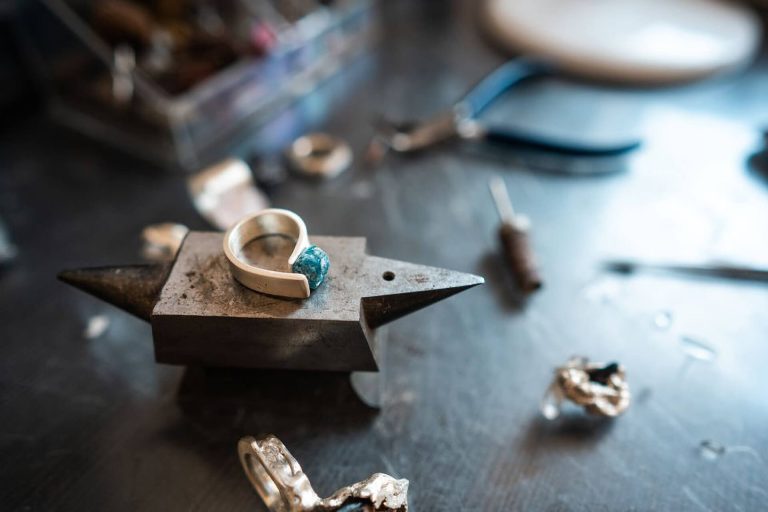
- The Bench Jeweler’s Nightmare: Standard commercial jewelry settings (baskets, prongs, and cast mountings) are engineered for balanced, linear proportions. An amateur stone cut with a heavy bulge simply will not sit flush in a mounting. It requires tedious, costly custom fabrication by a bench jeweler just to set safely.
🔬 Practical Tips for Your Next Faceting Design
How do you ensure your rough retains its value without becoming bulky?
- Preform Dynamically, Not Blindly: Don’t just follow the shape of the rough rind. Use your preforming step to establish a flat, clean pavilion cone or keel line that aligns with your targeted design angles.
- Trust the Critical Angle (And Add a Buffer): Always look up the RI of your material before cutting. If you are shifting angles to deepen color or adjust for a thin piece of rough, stay safely away from the critical angle limit to avoid leaking light.
- Prioritize Face-Up “Spread”: Aim for an efficient ratio between the stone’s total carat weight and its face-up surface area (mm × mm). A precision-cut gem should look its weight.
💎 Let’s Perfect Your Next Project
Navigating the delicate balance between color retention, weight yield, and brilliant light return takes time and practice. If you are struggling with a difficult piece of rough, trying to select the right faceting diagram, or want an expert eye to review your finished stones for commercial viability, we can help.
Our professional jewelry and lapidaries consulting service works one-on-one with amateur cutters and jewelry designers to optimize rough selection, fix cut proportions, and evaluate gemstone value.